Connect with us

IT and Telecomms

Revised AOL, Spectrum Pricing Regulations Will Strengthen Telecoms Market Structure, Enhance Competition – Danbatta

Published

on

, SiliconNigeria

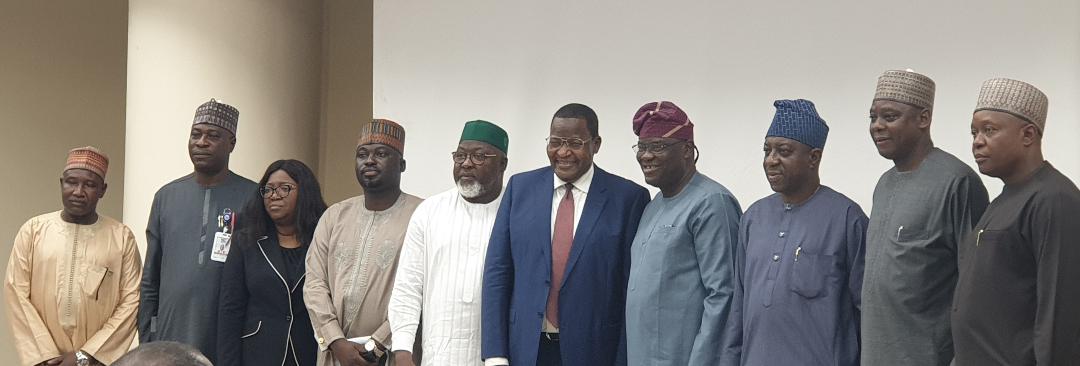
L-R: Muhammed Babajika, Director, Licensing & Authorisation; Oluwatoyin Asaju, Director, Spectrum Administration; Josephine Amuwa, Director, Legal & Regulatory Services; Salman Abdulazeez, Member, Board of Commissioners; Ubale Maska, Executive Commissioner, Technical Services; Prof. Umar Garba Danbatta, Executive Vice Chairman/Chief Executive Officer; Prof. Adeolu Akande, Chairman, Board of Commissioners; Adeleke Adewolu, Executive Commissioner, Stakeholder Management; Aliyu Shuaibu, Secretary, Universal Service Provision Fund (USPF) and Yakubu Gontor, Director, Financial Services, all of the Nigerian Communications Commission (NCC), at the public inquiry on two regulatory instruments held in Abuja on Thursday, July 29, 2021.

The Executive Vice Chairman (EVC) of the Nigerian Communications Commission (NCC), Prof. Umar Garba Danbatta, has said that the ongoing amendments to two major regulatory instruments of the Commission will help in strengthening and ensuring a fair and competitive telecoms market in Nigeria.

The two regulatory instruments are the Annual Operating Levy Regulations (AOL) and the Frequency Spectrum (Fees and Pricing, etc.) Regulations for which the Commission organized a public inquiry in Abuja on Thursday, July 29, 2021.

The first instrument on AOL ensures that all licensees are properly and equitably assessed for the annual   levy as well as meeting both statutory and regulatory expectations. Its review is expected to bring the Regulations in line with current realities and sustain the enviable contributions of the communications sector to the country’s Gross Domestic Product (GDP).

The second instrument on frequency spectrum fee and pricing enables the Commission to meet its sole and exclusive mandate in Section 21 of the Nigerian Communications Act (NCA), 2003 by assigning the scarce national resource in an equitable manner. The Regulations also ensures that frequency spectrum are assigned and managed in a way that ensures fair pricing and efficient deployment of attendant services.

Speaking during the event, Danbatta said the public inquiry not only reflects the Commission’s strategic mission and vision to ensure regulatory excellence through effective regulatory processes but also sign posts the Commission’s consultative approach to all its regulatory initiatives.

He said the public inquiry was a precursor to the Commission’s current drive to ensure efficiency in spectrum management and the unveiling of next generation services through varied enablers, adding that it was in this regard that the Commission issued a Spectrum Trading Guidelines (STG) in 2018, to ensure frequency Spectrum is readily available to licensees through an effective process.

“Furthermore, the Commission has commenced the process of deployment of Fifth Generation (5G) technology in Nigeria and is driving the provision of such ubiquitous services on making frequency Spectrum available to the licensees. The efficacy and reliability of the initiatives will be hinged on proper market valuation of the frequency spectrum and fair assessment of levies,” he said.

With the explosion in technologies, Danbatta said there has also been an attendant secondary reliance on different approaches to drive the best out of different frequency spectrum. He said this has led to the need for designation of several bands of frequency spectrum for communications services and a key illustration is the recent identification of some Spectrum frequencies for 5G deployment.

The EVC said the Commission is conscious of the expectations and the need to ensure that all regulatory instruments are made ready to meet these challenges, adding that this has made the reviews which the Commission is conducting an important milestone as the public inquiry in pushing the country to the front queue of this global efforts.

“Hence, we must be prepared on both ends of the industry to prepare the country for these remarkable changes; while the licensees continue to invest in deployment, the Commission will sustain its drive by ensuring regulatory efficiency and excellence,” he said.

Danbatta further acknowledged that the Nigerian National Broadband Plan (NNBP), 2020-2025, the National Digital Economy Policy & Strategy (NDEPS), 2020-2030 are all tailored to ensure that the Commission deploys new initiatives, build regulatory efficiency and ensure market stability.

He said the policy documents highlight the central nature of frequency spectrum in meeting most of their baseline objectives. “This has made the ongoing review not just necessary but inevitable to facilitate the attainments of these objectives,” he said.

Presentations were made on the comments, inputs and recommendations received from external stakeholders on the two regulatory instruments prior to the public enquiry as well as the amended sections and new provisions made to the two regulations.

Participants at the event made valuable contributions and raised issues that would assist the Commission in developing robust regulatory instruments that will continually contribute to the development of the industry and sustain its positive contribution to the nation’s economy.

The public enquiry was attended by the NCC’s Chairman, Board of Commissioners, Prof. Adeolu Akande; Chairman, Licensing Committee of the Board, Salman Abdul-Azeez; Executive Commissioner, Technical Services, Ubale Maska; Executive Commissioner, Stakeholder Management, Adeleke Adewolu; Senior Management staff and other industry stakeholders both physically and virtually.

Continue Reading
Advertisement Advertisement
Click to comment

Leave a Reply

Your email address will not be published. Required fields are marked *

Action

MTN Foundation Launches Skills Academy to Train 3 Million Nigerians

Published

on

, SiliconNigeria

The MTN Foundation has officially launched its Skills Academy, a transformative digital learning platform designed to empower millions of Nigerians with access to digital and financial skills essential for the 21st-century economy. The launch event, held at the Transcorp Hilton in Abuja, brought together top government officials, education stakeholders, and technology experts, reinforcing the importance of public-private collaboration in building a digitally inclusive Nigeria.

The platform, available at skillsacademy.mtn.com, is open to individuals aged 13 and above, whether in school, recently graduated, self-employed, or unemployed. It also features a career guidance tool to help secondary school students and other users explore pathways aligned with their strengths and market demand.

With youth unemployment over 6% and more than 18.3 million children out of school, according to the latest data from the National Bureau of Statistics (NBS) and the United Nations Children’s Fund (UNICEF), Nigeria faces a pressing need to close the digital skills gap. The Skills Academy directly responds to this challenge by offering free, self-paced courses and certifications in high-demand areas such as data analysis, software engineering, digital marketing, and project management.

In her welcome address, Dr. Mosun Belo-Olusoga, Chairman of the MTN Foundation (represented by Simon Aranonu, Director of the MTN Foundation), stated, “We believe digital skills are a truly powerful asset. No Nigerian youth or child should be left behind because of their socioeconomic background. This platform is designed to provide world-class learning experiences, helping Nigerian youth thrive and become future leaders.” To date, the platform has over 7,000 people learning and over 3,000 courses completed, setting a strong foundation for nationwide scalability.

The Honourable Minister of Communications, Innovation and Digital Economy, Dr. Bosun Tijani, in his keynote, described the platform as “unique and critical.” “Nigeria is a country that is extremely blessed. With an average age of just 16.9, we are one of the youngest populations in the world. This program is not just about training; it’s about equipping a generation that will drive innovation, deepen our economy, and position Nigeria as a net exporter of tech talent,” the Minister commented.

Odunayo Sanya, Executive Director of the MTN Foundation, added, “We are focused on building Africa’s largest digital talent pipeline. Through relevant and practical courses across various disciplines, offered in collaboration with the global e-learning platform Coursera, this web-based training system will be instrumental in promoting a digitally skilled workforce.”

This initiative is part of the MTN Foundation’s broader Digital Skills for Digital Jobs programme, which aligns with the Nigerian Government’s National Digital Economy Policy and Strategy (NDEPS) and Sustainable Development Goal 4: Quality Education.

Continue Reading

Cover Story

How Mobile Money Topped Two Billion Account Holders

Published

on

, SiliconNigeria

This is according to the ‘State of the Industry Report on Mobile Money 2025’ prepared by the GSMA Mobile Money programme which works to advance the mobile money ecosystem for communities worldwide that lack access to more traditional banking services. 

Its latest report finds that transaction volumes and values for mobile money accounts experienced robust double-digit growth in 2024. Approximately 108 billion transactions, totalling over $1.68 trillion, were processed through mobile money accounts in 2024. Year-on-year, transaction volumes increased by 20%, while transaction values grew by 16%, up from a 13% increase in 2023. 

In Sub-Saharan Africa alone, year-on-year, mobile money added around $190 billion to GDP in 2023, demonstrating its sustained economic influence. Sub-Saharan Africa remains the world’s most active mobile money region, driven by new registered accounts and rising monthly activity in East and West Africa. East Africa was the leading driver of monthly active account growth in 2024, followed by Southeast Asia and West Africa. 

Mobile money continues to play a key role in economic development. By the end of 2023, the total GDP of countries with mobile money services was over $720 billion higher than it would have been without them, reflecting a 1.7% increase in GDP driven by mobile money.

Vivek Badrinath, GSMA Director General comments: “Mobile money has emerged as a powerful driver of financial inclusion and economic growth. Its continued success depends on supportive regulatory environments that promote innovation, accessibility and help unlock the full socio-economic potential. To ensure mobile money remains accessible, affordable, and safe, it is vital for governments and regulators to work with financial service providers to support financial literacy programs, empowering underserved populations and opening new opportunities for financial decision-making.”

Continue Reading

IT and Telecomms

Africa’s Smartphone Market Surpasses Feature Phones for the First Time in Q1 2024

Published

on

, SiliconNigeria

Africa’s smartphone market showed remarkable resilience in the face of macroeconomic challenges and forex issues in Q1 2024, with shipments increasing 17.9% year on year (YoY) to reach 20.2 million units.

That’s according to the latest insights from International Data Corporation (IDC), with the firm’s newly released Quarterly Global Mobile Phone Tracker showing that feature phone shipments declined 15.9% over the same period to total 18.8 million units. This marks the first quarter where smartphone shipments have surpassed feature phone shipments in Africa, highlighting a clear transition toward smartphones across the region.

“South Africa experienced healthy YoY growth in Q1 2024, driven by the rising popularity and availability of competitively priced Chinese brands with advanced features,” says Arnold Ponela, a senior research analyst at IDC. “Meanwhile, Nigeria saw robust growth fueled by the success of Transsion brands and Xiaomi, particularly in the entry-level segment, which significantly boosted shipments. Kenya further strengthened its position as the third-largest smartphone market in Africa in Q1 2024, with innovative financing models like Mkopa driving sales growth.”

In Q1 2024, Transsion brands (Tecno, Itel, Infinix) maintained their leading position in terms of smartphone market share, driven by their compelling entry-level device portfolio tailored to the African market. However, Samsung and Xiaomi gained market share on the previous quarter, driven by mid-range ($200<$400) models. Overall, shipments of smartphones in this price range increased in Q1 2024, while shipments of <$100 devices declined, indicating a growing consumer preference for feature-rich models.

Looking at 2024 as a whole, IDC expects Africa’s smartphone market to see shipments increase 5.7% YoY, with a sustained upward trajectory for the next five years. “Africa remains a market with a high share of feature phones, although they are expected to gradually decline as the transition to smartphones gains momentum,” says Akash Balachandran, a research manager at IDC. “This shift, coupled with rising demand, will be the key driver of overall growth in the smartphone market. Persistent inflationary pressures and escalating macroeconomic uncertainties may cause short-term fluctuations but will not impede the long-term transition.”

Continue Reading

Popular News